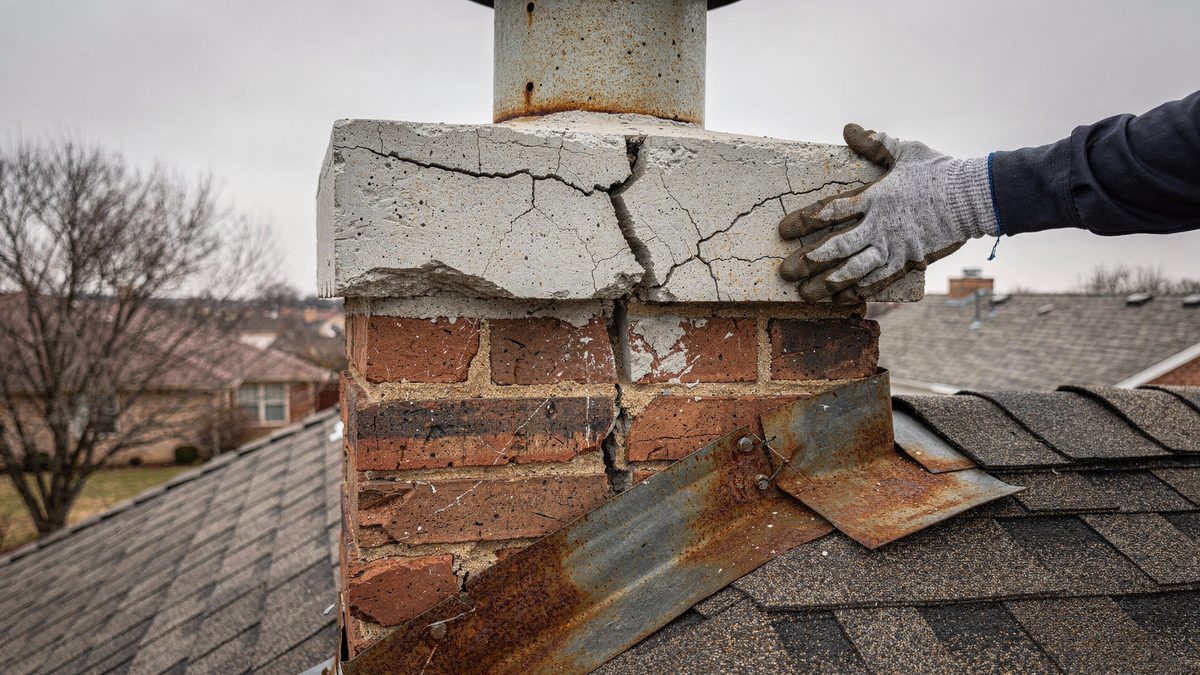
The Cap Is the Cheapest Part of the System
A cap covers the flue opening with a screened enclosure and a lid. It keeps rain out of the flue, keeps birds and squirrels from nesting in it, and arrests sparks leaving it. It is the least expensive component on the whole chimney and the one most often simply absent.
An uncapped flue takes rain directly onto the smoke shelf and damper. That is how dampers rust shut, how the firebox stains, and how the acidic mix of water and creosote starts working on the liner from the inside.
Chase Covers Are Not Caps
If your fireplace is factory-built, the chimney is usually enclosed in a framed chase with a metal cover on top. That cover is a chase cover, not a cap, and the two fail differently. Galvanised chase covers rust through from standing water at the low point, and the first symptom is usually rust streaking down the siding.
Stainless replaces them and does not do that. It is also worth noting that the Oklahoma Residential Code §R1004.3 prohibits decorative shrouds on factory-built fireplace chimneys unless the shroud is listed and labeled for that specific system. Generic shrouds are common here and they are not compliant.
Flashing Is Roofing, and Roofing Is Registered
Flashing is the layered metal that seals the joint where the chimney passes through the roof plane: step flashing woven into the shingle courses, counter flashing let into the masonry above it. Done right it sheds water without relying on sealant. Done wrong, or "repaired" with a bead of roofing tar, it leaks and the leak looks like a chimney problem when it is a roof problem.
This part is not unlicensed. Flashing sits inside a roofing system, and Oklahoma requires roofing contractors to register annually with the Construction Industries Board under 59 O.S. §1151.3, with $500,000 general liability for residential work. Ask who is doing the flashing and whether they hold that registration.
Diagnosing a Chimney Leak
Water showing up near a chimney has four candidate paths and they are cheap to rule out in order: the cap or chase cover, the crown, the masonry face and joints, and the flashing. Working top down costs less than opening the ceiling.
A stain that appears only during wind-driven rain usually points at the masonry face or the flashing. A stain that appears in every rain points higher up.
Caps & Flashing Available In
- Tulsa, OK Tulsa County
- Broken Arrow, OK Tulsa and Wagoner Counties
- Jenks, OK Tulsa County
- Owasso, OK Tulsa and Rogers Counties
- Bixby, OK Tulsa and Wagoner Counties
Chimney Questions, Answered
- Do I need a chimney cap?
- Yes. It is the cheapest component on the chimney and it prevents rain, animals and debris from entering the flue. An uncapped flue puts water onto the damper and smoke shelf every time it rains.
- Who should do chimney flashing, a roofer or a sweep?
- Whoever holds Oklahoma roofing contractor registration, because flashing is part of the roofing system. Some chimney companies carry it, some subcontract it. Ask which, and ask to see the registration.
- What is the difference between a crown and a cap?
- The crown is the sloped masonry or concrete slab covering the top of the chimney structure. The cap is the metal-and-mesh cover over the flue opening itself. A chimney needs both, and they fail independently.