The Three Levels Are NFPA's, Not a Company's
Worth stating plainly, because the industry shorthand obscures it: the inspection levels are defined in NFPA 211 Chapter 15. They are not a CSIA product or a marketing tier. Any sweep quoting you a "Level 2" is quoting a national standard, and you are entitled to ask which clauses of it they are performing.
The standard also says the scope, the areas examined and the degree of invasiveness shall be appropriate to the conditions that prompted the inspection. The level follows the situation, not the price list.
Level I: The Annual Baseline
Level I applies when nothing has changed: same appliance, same use, verifying the chimney is fit for continued service. It covers readily accessible portions of the chimney exterior and interior, the accessible appliance and connection, confirmation the flue is free of combustible deposits and obstruction, and examination for proper clearances and observable malfunction.
It is what accompanies a routine cleaning. It is also, per §15.3.1, what the annual inspection requirement in §14.2 is satisfied by.
Level II: Sale, Fire, Weather, or a Changed Appliance
This is the one people get wrong. NFPA 211 §15.4.1 requires Level II in four situations, and two of them are common: upon sale or transfer of the property, and after a building or chimney fire, weather or seismic event, or other incident likely to have caused damage. The other two are before relining a flue, and when an appliance is added, removed or replaced with one of dissimilar type, input rating or efficiency.
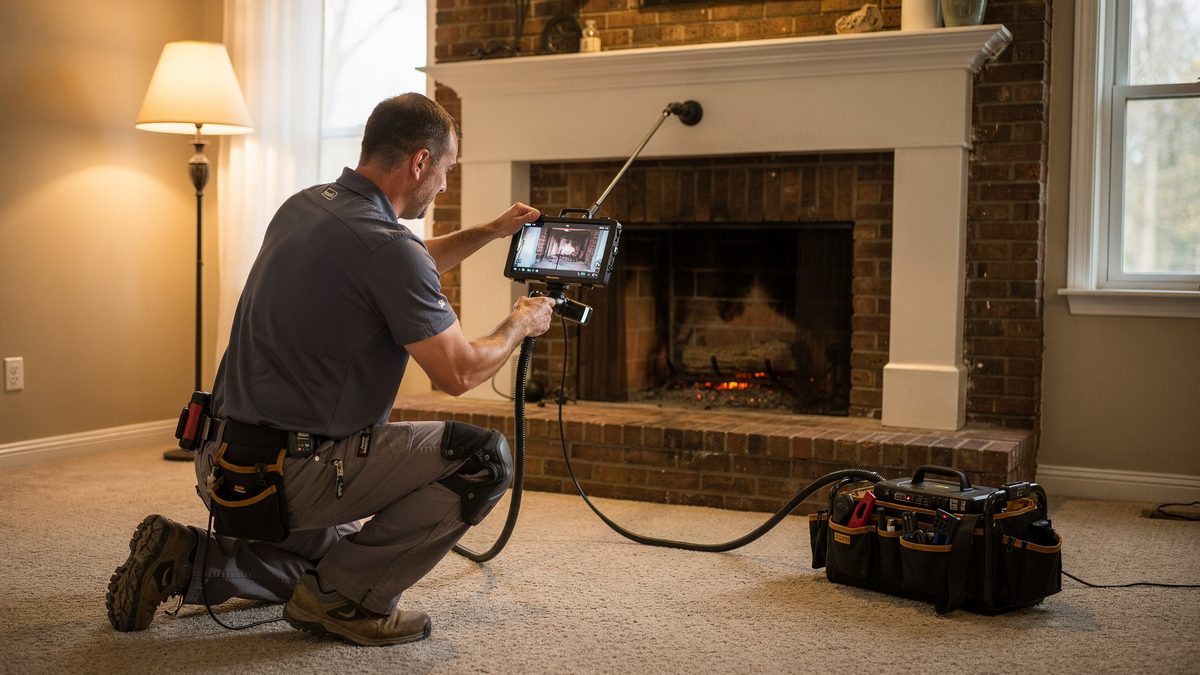
Level II adds accessible attics, crawl spaces and basements, verification of clearances to combustibles at accessible locations, evaluation of flue sizing and lining material for the connected appliance, and examination of the flue interior with video scanning equipment. If you are buying a house in Tulsa with a fireplace, this is the inspection to ask for.
Level III: Only Where the Others Cannot Reach
Level III is deliberately narrow. §15.5.1 restricts it to the areas suspected of damage that a Level I or II cannot properly evaluate, and it permits removal of building or chimney components only as necessary to reach them.
It is the investigative level: after a fire or event known to have caused damage, or when a hazard found at Level I or II cannot be evaluated without opening a concealed area. Nobody should be selling you a Level III as a routine service.
Chimney Inspection Available In
- Tulsa, OK Tulsa County
- Broken Arrow, OK Tulsa and Wagoner Counties
- Jenks, OK Tulsa County
- Owasso, OK Tulsa and Rogers Counties
- Bixby, OK Tulsa and Wagoner Counties
Chimney Questions, Answered
- Do I need a chimney inspection to sell a house in Oklahoma?
- No state statute requires one, but NFPA 211 §15.4.1 calls for a Level II inspection upon sale or transfer of the property, and lenders and buyers' agents commonly ask for it. Confirm what your specific transaction needs early.
- What is the difference between a Level I and a Level II?
- Access and instrumentation. Level I covers readily accessible areas. Level II adds accessible attics, crawl spaces and basements, checks clearances and flue sizing, and includes video scanning of the flue interior.
- My chimney had a fire. Which level do I need?
- Level II at minimum, because NFPA 211 requires it after any incident likely to have caused damage. If the fire is known to have caused damage, or a Level II finds something it cannot fully evaluate, that escalates to Level III for those areas only.